Welcome to the Elstree & Borehamwood Museum blog.
This blog is about all those happenings inside and outside the Museum that have caught our attention.
From events and exhibitions, to new discoveries in the collections, to news and views.
Any comments and items to go here please contact Simon on info@elstree-museum.org.uk
Whilst the Museum is closed and our collections unable to be seen by visitors, we have created a weekly virtual museum with an Object of the Week feature from our collections.
Object of the Week : Y is for Yavneh College
Borehamwood’s only Jewish state school opened in 2006 on the site of the former Hillside School in Hillside Avenue. It took seven years to get the project off the ground, and a further five years until a sixth form was opened. The secondary school has a synagogue on site as well as sporting facilities and a large assembly hall.
In 2014, the Museum hosted a temporary exhibition commemorating 75 years of Hillside School, which had closed in 2000. This was in conjunction with former Head Master Keith Newsome. In our collection we have a variety of Hillside items such as log book, photographs, school production memorabilia and an LP of Hillside Band Music.


The school had a dramatic start. It was due to open as a new centre for secondary education on 4th September 1939, but when War was declared on the previous day, the school’s governor’s followed instructions from the government and did not proceed with the opening. The school fully opened on 20th November 1939; 81 years ago this week. The school’s first days were eventful, not only due to Wartime measures, but also due to a large piece of plaster falling from the roof of the new Assembly Hall.
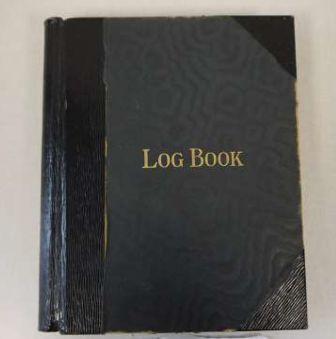
On October 21st 1940, the Log Book (see photo) records that the local gunfire and proximity of enemy planes prevented the dismissal of children until the All Clear was sounded at 1.15pm. That same day, more disruption occurred when a second alert sounded at 1.45 and the All Clear at 3.45. The Afternoon Session had to be cancelled and all children dismissed.
In the 1960s, the school witnessed a major change in the education system when the school leaving age rose from 14 to 16. For this, the school needed a new building and in 1966 a ‘RoSLA’ (Rising of School Leaving Age) Unit was built on the front lawns.
If you went to Hillside School or Yavneh College and wish to share your memories with us, please do get in touch: info@elstree-museum.org.uk

Whilst the Museum is closed and our collections unable to be seen by visitors, we have created a weekly virtual museum with an Object of the Week feature from our collections.
Object of the Week : X Is For Xmas Decorations
We may be a little ahead of the game but this week’s object is X for Xmas Decorations. And where was the most popular place in Borehamwood to purchase such items? In everyone’s favourite – Woolies.
Much of the history of the Woolworths has been covered previously on our Facebook page, so here we share some of your memories.


There were only two locations in Shenley Road for Woolworths. The first started off in the row of shops between Cardinal Avenue and Whitehouse Avenue (on a site previously occupied by BBE Evans). Local lady Brenda remembers: - “it was there in 1952 as l remember going there with my dad to buy a roll-a-ball game!”
The second location was where Iceland stands today, until it closed on 27th December 2008. In the Museum’s collection is the last ever Christmas catalogue produced and a selection of Christmas baubles and decorations to stir a few memories. It had a pick ‘n’ mix counter and a child’s ride just inside the store, in the form of a pink animal that rocked back and forth.
“In the 1960s, it had staff behind the individual counters rather than at one pay area.” Paul Welsh
“You could buy most things for 6d and got a lot for your money. In later years there was a record department where I bought my LPs” David Armitage


“Woolies, as it was affectionally known, had island counters for different things, each island having its own till and the floor was just wooden floorboards.
It was the place to go to for everyday items at sensible prices, from broken biscuits, pick and mix sweets to clothes, household items, records and DIY supplies. They sold wonderful Christmas decorations - some my mum bought 60 years ago l still use every December” Brenda Treacher.
Why not share your memories and photos with us? Contact info@elstree-museum.org.uk and we will add your contributions to this Blog.


Whilst the Museum is closed and our collections unable to be seen by visitors, we have created a weekly virtual museum with an Object of the Week feature from our collections.
Object of the Week : W Is For Wellington

This week we turn the spotlight on another of our much loved local establishments. W is for Wellington Pub.
When this pub closed in 2018, we all thought it was the end of it and a block of flats would occupy the space. One of the Museum volunteers raced down to take some photos of the old pub interior before it disappeared for good.


These pictures have been added to our photo collection archive along with some pub memorabilia which was donated to the Museum. Also, not long before it closed, EastEnders filmed a scene in the bar.
Happily though, the pub was refurbished and re-opened and can still be enjoyed today. Here’s a snapshot about its past.
The building started life as a beer house named The Jolly Sailor in 1850. It looked much like a house on the street with a porch over the front door. Late in the 19th century it was renamed The Wellington. This may have had something to do with JBB Wellington starting up a photographic factory in Borehamwood in 1895. The building was almost totally rebuilt in 1908 with a facade that looks much like today. In the 1930s it also became known as The Wellington Hotel. This coincided with the start of the local film industry so possibly there was a need for renting rooms.
There had been very little cosmetic change over the following years until the recent refurbishment.

Fellow W pub was the Woodcock in Croxdale Road, which was closed for good in 2006 after a troubled past. In 2007 it was burnt down before finally being demolished and a block of flats being built onsite.


Whilst the Museum is closed and our collections unable to be seen by visitors, we have created a weekly virtual museum with an Object of the Week feature from our collections.

Object of the Week : V is for Village Hall
Housed on the site that was the much loved Village Hall, the Museum has close links with this building which played a big part in community history and local memories. We have a collection of photos of the Village Hall on our archive database. We always welcome more photos for our collections, so please do share if you can.
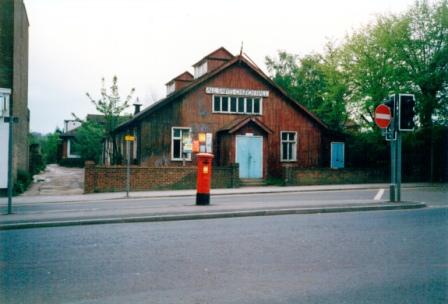
The 'Village Hall' known as the Church Hall, was opened next to All Saints Parish Church on Friday 2nd February 1926. The following afternoon a whist drive took place followed by a public dance with the 'Pogo' orchestra of banjo, piano, violin and cello. On Sunday the hall was welcomed for use by the Sunday school. Thus began an extension of the social life of the growing village of Borehamwood.
The prefabricated corrugated iron structure of the Hall was inspired by the social hall belonging to the Wellington and Ward photographic factory in Shenley Road (known as the Dufay Hall when that firm had the premises.) The 1920s saw the era of ‘Tin Tabernacles’ made of this metal, which resisted bending.
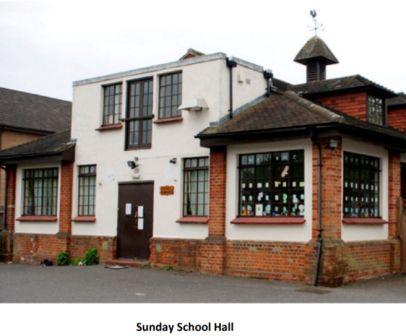
By 1936 arrangements were completed for the erection behind the Village Hall of the new brick built Sunday School Hall. During World War II the Village Hall, because of the central position, was requisitioned for government use. In the early War years it was an A.R.P. Post and ambulance station, also used in liaison with Police and Fire Services and local Hospitals, and with public utilities for water, gas and electricity. From 1943 the Village Hall did service as a ‘British Restaurant’ run by the government at subsidised rates, providing lunchtime meals, (ration book free ) for one shilling. Along with these activities, on Saturday afternoons the Hall was transformed for evening dances; a welcome social event for Servicemen and women based in the area mixing with local people.

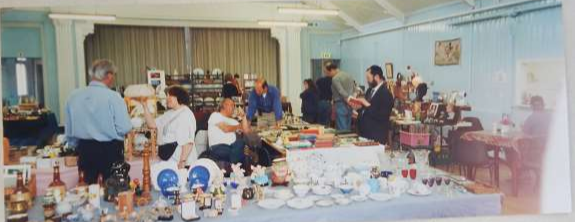
In the 1950s both the Village Hall and the Sunday school hall were being used for a great deal of community and church related activities, meetings, dances, Easter and Christmas bazaars, The May Festival, Scouts and Guides, jumble sales, plays, film shows, exhibitions, cage bird shows, garden show, whist drives, annual dinners, talks, concerts etc. An interesting record of diversity. A weekly ‘flea’ market thrived until it closed down. Blood donation sessions were held there as well on a regular basis. In the late 1950s and early 1960s ‘Lucky’ Parkinson promoted Rock & Roll shows in The Hall, and the likes of Screaming Lord Sutch & The Savages, The Brook Brothers and Johnny Kidd & The Pirates would shake the foundations.
During the mid 1990s, a working party was set up with All Saints Church liaising with the Trustees to look into the future of the halls. One idea was to demolish the front hall, remove the wooden pews from the church and use the church space as a multi purpose facility for the community. However, by this time the front hall had become rather dilapidated and despite a makeover it remained in a poor state. Yet the hall, being in such a central location was a much loved and missed feature of the village.
By October 2008 plans were prepared for the new community hall. This was to be a building of substance, balancing All Saints church itself, rising a storey above nearby shopping premises. The Library was to be accommodated with the inclusion of the Local museum and various meeting halls and rooms. The multi functional community building of 96 Shenley Road opened in 2013.

Whilst the Museum is closed and our collections unable to be seen by visitors, we have created a weekly virtual museum with an Object of the Week feature from our collections.
Object of the Week : U for Underwear
The Museum has a rather nice collection of lingerie produced by Keystone Knitting Mills. As the history of Keystone has been covered previously in ‘K’, it doesn’t need repeating here. Also, we all know what underwear is and what its functions are, so that’s probably best not repeated here either. However, these are items of a Museum collection, so let’s look at a bit of history.
The earliest undergarment to be worn by human beings is thought to be the Loincloth and as Tarzan fans will know, sometimes in hot weather would have been the only item of ‘clothing’ to be worn. In colder climates, the loincloth would be worn under other garments. The fabric used for loincloths was believed to have been either wool or linen or a coarse twill. Scratchy.
As time progressed, men wore cod-pieces and ladies wore bodices which later became corsets.
By the early 20th century, textile industries like Keystones were booming. Whalebone corsets began to be relaxed and be replaced by the liberty bodice. Advertising for underwear first began in 1910 in the US and by the end of the decade, the requirement was for ladies to have underwear in which they could pursue sporting activities, so the bloomers were born.
In the 1930s, the girdle revived the fashion for the corset, but without the whalebone and accompanied by a brassiere and garters.
From the 1950s onwards, underwear became more of a fashion item in its own right and items such as the Wonderbra, Pantyhose (or tights), brief and boxer shorts came into production.


Whilst the Museum is closed and our collections unable to be seen by visitors, we have created a weekly virtual museum with an Object of the Week feature from our collections.
Object of the Week : T is for Thatched Barn
The Museum has a large collection of photos of the Thatched Barn, now the Holiday Inn on the Barnet By-Pass. This building has had a colourful past and our archive photo collections reflect this. There have been parties, summertime gatherings around the former heated swimming pool, car accidents in the 1930s, secret wartime activities and fires in the 1960s. Here are some unseen photos from the opening night collection in 1934.


The hotel had elaborate dining facilities and being so close to the film studios, it became a glamorous hang-out for the film stars of the 1930s. It was bought by holiday camps’ founder Billy Butlin in 1939 but then during the Second World War, the building was requisitioned by the Special Operations Executive (SOE) who developed explosive devices, camouflage and coding equipment, using the local expertise found in the studios. By the end of the war, the building had fallen into disrepair and the owner went bankrupt. But then, in the 1950s, the Ministry of Works used the Thatched Barn as its Building Research Station.


In 1962 it suffered the first of a series of fires which damaged the thatched roof for which it was famous. It then became a Playboy Club for a brief period in the Sixties but prohibitively high prices and an exclusive membership ensured its eventual failure. The Thatched Barn was demolished in December 1989.
Whilst the Museum is closed and our collections unable to be seen by visitors, we have created a weekly virtual museum with an Object of the Week feature from our collections.
Object of the Week : S is for Shopping


Carrier bags are contentious these days, outlawed for their plastic content but they also have an evocative quality, reminding us of shops past and present. The Museum holds a collection of various bags from shops long gone in Borehamwood, together with other shop related items, including weighing scales, receipts and shop-front lettering as well as a large archive of photographs.


The story of shops and shopping in Borehamwood may be said to start with ‘Robinson’s Folly’; a row of shops on the east side of Theobald Street in 1871. In fact, Theobald Street was where almost all the earliest shops and houses were situated and was the original village centre which is why Borehamwood folk say “ going down the village” to this day.
In 1939, Borehamwood was a small town developing around its main thoroughfare, Shenley Road. Until the mid-1920s, most shops and houses had been built at the west end of the road; the east end was mostly isolated. By the mid ‘20s the film studios arrived and housing sprung up. New shopping parades followed in the late 1940s and were mainly completed by the end of the 1960s. Shenley Road looks much today as it did then.


Tesco and Sainsbury’s were some of the first multiple stores to introduce self-service. Tesco came to Borehamwood circa 1954 and was first positioned opposite Whitehouse Avenue, where Borehamwood Café is today. By the late 1950s it then occupied the site where Lots of Rice now stands and then the current site of the Reel Cinema in the 1980s. It finally moved to its present position on former Elstree Studio land in the 1990s.

Whilst the Museum is closed and our collections unable to be seen by visitors, we have created a weekly virtual museum with an Object of the Week feature from our collections.
Object of the Week :
R is for Red Lions – Three of them!
Elstree and Borehamwood has had its fair share of pubs named Red Lion.

The Red Lion Hotel on the crossroads at Elstree was a timber framed building and first mentioned in 1656. It stood on the East side of the High Street on the corner of Barnet Lane and was demolished in 1934 to allow for the widening of the road.

This is the Red Lion in Shenley Road which is now McDonalds but previously was a pub since the mid 1930s. This was particularly popular with film stars from the Studios across the road, who would pop in for a drink and chat with fellow actors. A darts team from the old Red Lion in Borehamwood was almost crowned national pub champions when they took part in a tournament in the late 1940s. On Wednesdays in the 1960s it was home to the Boreham Wood & Elstree Folk Music Club where many up-and-coming artists played from Sandy Denny to Bert Jansch. And on Saturdays featured middle of the road and cabaret artists such as Lennie Peters, later to be one half of top popsters Peters and Lee.

Here we see the Old Red Lion in Green Street which closed in the late 1960s. In the 1940s and 1950s life used to revolve around the Red Lion pub and the area had a real sense of community. The interior was described as very Spartan with bare boards on the floor and no carpets and served real ale. There was no licence to sell spirits and wine wasn’t as popular then as it is today. The pub had two bars but according to local memories, one was seldom used.
Whilst the Museum is closed and our collections unable to be seen by visitors, we have created a weekly virtual museum with an Object of the Week feature from our collections.

Object of the Week :
Q is for Queen – the Pearly variety
This is one of a large collection of unusual hand-made paper figures made by W.H Gilby. Mr Gilby worked as a draughtsman at BSP Industries in Maxwell Road, Borehamwood, which was founded and owned by Ivor Bailey. BSP was home to the largest European engineering drawing office of its time. Ivor Bailey’s name might have a familiar ring locally too because he gifted the Maxwell Park community centre to the youth of Borehamwood in 1962 and financed the building work.
Mr Gilby was Ivor Bailey’s right hand man and he made the paper figures as table decorations for the annual dinner given by BSP. Gilby also drew this image of the old Holly Bush inn.


Whilst the Museum is closed and our collections unable to be seen by visitors, we have created a weekly virtual museum with an Object of the Week feature from our collections.
Object of the Week : P is for Phoenix and Paul Welsh

In the Museum’s collection is this painting of a Phoenix, which hung in the foyer of Elstree Studios.
The Phoenix rising from the ashes logo was adopted to symbolise the Save Our Studios campaign’s success at putting Elstree Studio back on the map. This photo of Paul Welsh, Chair of the Studio at the time, was taken in 1996 when the Studio reopened. It shows Paul with actress Ingrid Pitt; best remembered as a Hammer films icon and for appearing in Where Eagles Dare, which was made at MGM in Borehamwood.

Show only:
» Events
» Collections
» News
» Exhibitions
Elstree & Borehamwood Museum
96 Shenley Road
Borehamwood
Herts
WD6 1EB
Tel: 01442 454888


Admission: Free
Opening times:
Opening times:
Tuesday, Wednesday, Thursday
12pm - 6pm
Saturday 10am - 3pm
Registered Charity No.1157770


