Welcome to the Elstree & Borehamwood Museum blog.
This blog is about all those happenings inside and outside the Museum that have caught our attention.
From events and exhibitions, to new discoveries in the collections, to news and views.
Any comments and items to go here please contact Simon on info@elstree-museum.org.uk
Whilst the Museum is closed and our collections unable to be seen by visitors, we have created a weekly virtual museum with an Object of the Week feature from our collections.
Object of the Week : L is for Lamps and Lillies

There are many Wartime related items in the Museum’s collection and this week, two objects have been selected connected with this period of history.
The first is a hooded lamp used by ARP wardens during the blackout. The hood prevented the light from shining upwards but was still bright enough to be useful. The lamp could be carried by hand or clipped onto a belt.
The second is a flier for a performance of Lillies On The Land at the Ark Theatre in 2012. The play celebrates the Women’s Land Army of World War II. It was a story based on letters and interviews with original Land Girls.


So what was happening in Elstree and Borehamwood during Wartime? A number of significant events occurred. The Army took over Elstree Preparatory School to use for billets and training. They also requisitioned British International Pictures and Gate Studios for use as stores, whilst the Ministry of Health claimed the newly completed Amalgamated Studios.
The Thatched Barn became the centre for the Special Operations Executive (SOE). By June 1942 it was a busy hub of activity for the Inter-Services Research Bureau and because of its sensitive nature ‘did not exist’. But, had you glimpsed inside at this time, you might have seen SOE parachutists jumping off the restaurant balcony and a small submarine undergoing tests in the swimming pool!
Elsewhere, A.B.P.C Studios acted as a store for materials including decoys. Aeroplane parts were constructed in what was to become MGM Studios. Laing’s factories along the Elstree Way also produced aeroplane parts and in Lyndhurst House, the army had set up a wireless interceptor station.
In 1940 when an invasion appeared imminent, many local men volunteered for the LDV (Local Defence Volunteers or Home Guard). Locals referred to the area as a ‘garrison town’ because of the large number of troops stationed here. A house in Shenley Road was hit by a bomb and a house on the corner of Cardinal Avenue and Hillside Avenue was destroyed by a high explosive bomb, and in 1944 a V1 (doodlebug) flying bomb fell in a field near Tennison Avenue.
A family of four were killed instantly when a landmine hit a house in Fortune Lane, Elstree in 1940. The Handbury family (Ralph Handbury was Managing Director of RKO Radio operations) came up to Elstree from Hampstead to escape the London Blitz, only three weeks before. The house, ironically called The Fortune, was destroyed.
Whilst the Museum is closed and our collections unable to be seen by visitors, we have created a weekly virtual museum with an Object of the Week feature from our collections.
Object of the Week : K is for Keystone Knitting Mills


Keystone Knitting Mills was a major employer in Borehamwood for more than 40 years. Keystones was built in 1927 and opened a year later on a site between Glenhaven Avenue and Clarendon Road now occupied by ‘the Boulevard’ shopping park. The factory produced pure silk seamed stockings and lingerie. The Museum has a large collection of items relating to Keystones, including a letter of a job offer. People would come from as far away as the North of England to work at the factory after the Depression in the early 1930s. During the Second World War, part of the factory was taken over for munitions work and silk parachutes were produced on site. It was also used as a drawing office for aircraft parts.
Some of the Museum volunteers had relatives who worked in the Factory. Actors and Actresses modelled for the company, which made a great deal of garments for the film industry. Fully fashioned stockings went out of favour in the 50's and tights were manufactured instead. Keystones closed in 1958 and moved to Wales. The site eventually became the Boulevard in the 1980s. Here are images of their silk thread and stockings, their local activities, and the current Keystone Passage in the 1980s before demolition.


Whilst the Museum is closed and our collections unable to be seen by visitors, we have created a weekly virtual museum with an Object of the Week feature from our collections.
Object of the Week : J is for Jubilee Kitchen Towel!

Well if the Garden City Museum in Letchworth can win Hertfordshire Museums Object of the Year Award for an 83 year old toilet roll and have the story taken up by the BBC and the Sun Newspaper, then Elstree and Borehamwood Museum can celebrate its Golden Jubilee Kitchen Roll from 2002. A little secret – this is one of the collection team volunteers’ favourite object!
The Kitchen Roll is part of a small collection of souvenir items produced in celebration of the 50th year of the Queen’s reign.


Whilst the Museum is closed and our collections unable to be seen by visitors, we have created a weekly virtual museum with an Object of the Week feature from our collections.
Object of the Week : I is for Illustrated News


These engravings appeared in the Illustrated London News in the mid 1800s. The artist was one Frederick Tayler, whose watercolour paintings the Museum has in its collection.
Tayler was a famous 19th Century English landscape and watercolour painter and President of the Royal Watercolour Society. He was a particular favourite of Queen Victoria.

He was born in Boreham Wood in 1802 and at one time lived in Barham House, Elstree. Educated at Eton College and Harrow School, it was here he began to show artistic talent as a painter. He pursued his ambition by attending Sass’s School before moving onto Paris and Rome. Henry Sass was an English artist and teacher of painting, who founded an important art school in London to provide training for those seeking to enter the Royal Academy. Many distinguished British painters received their early training here including John Millais
Cottage Life is one of his works which resides in the Museum’s collection.
More of his works can be found here For additional information about his life, please see our Newsletter 17 here :
Whilst the Museum is closed and our collections unable to be seen by visitors, we have created a weekly virtual museum with an Object of the Week feature from our collections.
Object of the Week is H. It has to be H for Hanson’s
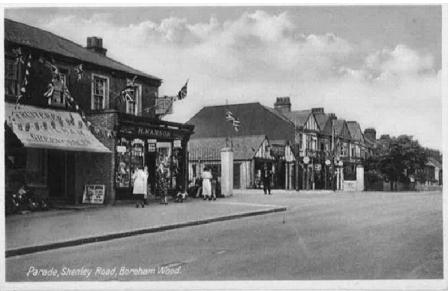

Here is just a selection of the Hanson Shop memorabilia in the Museum’s collection :
Sheet of Sandwich Labels
Hanson’s Executive Luncheon Menu
Christmas Letter from Hanson’s, 1st December 1996 with Menu
Hanson’s Menu Booklet April 2000


Penny Sweets & Tizer Floats
Hansons Sweetshop and Tearoom is probably the most fondly remembered family establishment in Borehamwood. Standing on the corner of Shenley Road and Keystone Passage, this little shop was most famous for the delicious homemade ice cream; described as ‘blissful’ by some.
Elsie and Bert Hanson from Huddersfield took over a sleepy Borehamwood village store with its small tearoom in 1933. The later, more familiar tearoom was made ready by 1954. When wartime sweet rationing ended in the early 1950s, a huge queue formed outside Hansons and all confectionary stock quickly sold out.
In addition, the business also acted as a booking agent for a local coach company, offering trips to coastal resorts and abroad.
Elsie and Bert’s children, Mary and John, later ran the business until its closure in 2001. Many remember the iconic fireplace, on which sauce bottles would be stored, the serving hatch, the gingham table cloths and wooden paneling. Most fondly talked about though are the ice cream tizer floats, black cherry ice cream sodas, sausage rolls, meat pasties, toast and beef dripping and take-away sandwiches.
The decision to close the tearoom, part of the oldest retail outlet in Borehamwood for nearly 70 years, was a very sad day for their customers.
H is also for History

Did you know, we have a specific team of volunteers here at the Museum, whose role is to work with the collections? This team is responsible for documenting, photographing and cataloguing every object in the Museum’s entire collection. The team work with all kinds of objects ranging from photographs, stories, oral history collections and all manner of Borehamwood related items.
It’s not just old things we collect, we welcome objects which reflect life in the current time, as this will too become history one day. Therefore, as this current situation with Covid 19 unfolds, if you have any items which you think might be of interest reflecting this time in our history, please keep them aside for the Museum to consider as a potential acquisition. Do bear in mind that we will not be able to keep everything, and we will review and process any material offered at a later date. Thank you.
Whilst the Museum is closed and our collections unable to be seen by visitors, we have created a weekly virtual museum with an Object of the Week feature from our collections.
G: is for Games


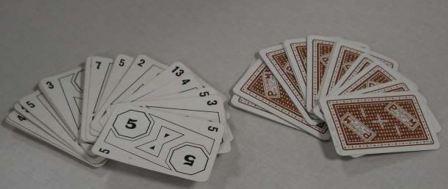
We must all have played a few board games during this lockdown. But how many of you have this game in your vintage collection? Originating from the mid 1930s, this week’s Museum Object is called PM. It stands for ‘Plus Minus’ but it’s slogan was: Play PM to AM! It boasted it was “the most intriguing game ever invented, the game everyone has been waiting for for years!” And: “Absorbing for the Adults, Interesting & Instructive for the Children”.
Its rules were so simple, they could be summed up in one paragraph.
Each Player has a board and 4 men. The object is to move the 4 men from the stars at the top of the Board onto 25. Eleven cards are dealt to each Player. A Player plays any card from his hand and adds the number on it to the number on the TOP CARD ONLY. (i.e. the card that was played by the previous Player) moving one of his men accordingly. Men driven over 24 return to stars and restart. The Minus Cards are subtracted.
Scoring was thus:
50 points for every man on 25
20 points DEDUCTED for every man still on the stars at the top of the board.
Other men score according to the number they occupy at the end of the game.
The object of the game is to move the men from the stars at the top of the board on to the 25 at the bottom. The finish of the game is when one of the players has moved his four men on to the 25 or alternately when the last player has played his last card and moved accordingly.
NOTE CAREFULLY - NO FURTHER MOVE CAN BE MADE after one player has moved his fourth man on to 25.
The game comes with Rules, 4 playing boards, 4 sets of 4 playing tokens, deck of cards.

Whilst the Museum is closed and our collections unable to be seen by visitors, we have created a weekly virtual museum with an Object of the Week feature from our collections.
F – Furzehill Middle School Jumper

The Museum has many items of school uniform and Furzehill is no exception.
Furzehill School opened on 14 October 1912 and was called Boreham Wood County Council School. It was the first County Council School to be built in the parish. It began life as a Junior Mixed Infant School and then became a Middle School in 1974. A pupil who attended in 1947 described the school as: “from the Victorian era with tiny windows high in the wall, outside toilets, and the ever present smell of fresh paint on hot radiators.”
In 1949, the school was destroyed by fire. Luckily there were no pupils present at the time as it happened around ‘teatime’, so no one was hurt. One pupil described how his father rushed home and sat the boy on the child seat of his bicycle to see Furzehill School “ablaze from end to end.”
Other locations had to be utilised so that schooling could be continued, including Shenley Village Hall and Hill House in Elstree. Furzehill was rebuilt but closed in 2001. It was demolished in 2006. Housing and a children’s centre now stand in its place.
With thanks to Eve Glover and John Gates.

Whilst the Museum is closed and our collections unable to be seen by visitors, we have created a weekly virtual museum with an Object of the Week feature from our collections.
Object E : Elstree Pubs
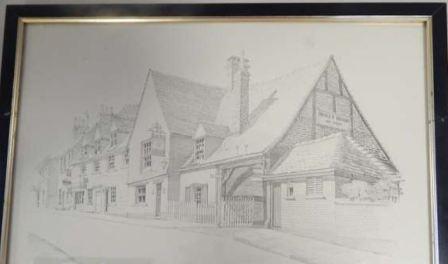
The Museum received a set of framed sketches of Elstree Pubs as a donation, which included Artichoke, Red Lion, Holly Bush and Plough. It is the Hollybush we have chosen as our object of the week.
Elstree Hill at one time was a busy coaching stop on Watling Street. The Hollybush was the last survivor and the oldest of all the pubs in Elstree village. It was extended in the 1980s when the coaching arch was removed and the outside toilets moved to the rear of the pub. Since the building was constructed in around 1450, the road level has risen, causing customers to step down into the bar. Many of the original beams exist, including those supposedly coming from Newgate Prison, and the original inglenook fireplace.
The first mention of it as an Inn was in 1786 when it was owned by Thomas Clutterbuck and managed by John Green. The Inn featured in an episode of Most Haunted in recent times.

It closed in 2009, along with The Artichoke further down the hill. Both inns were said to have great views of the surrounding countryside. The Artichoke, a short distance from the junction with Allum Lane, is first mentioned in 1750 when it was kept by Philip Cogdell. It was here that a number of inquests took place including that of William Weare who was murdered in 1823.The Birmingham to London stagecoach stopped here twice daily in the 1830s. It too has recently ceased to be a pub and is now the area’s first Shtiebl - a Jewish education and community centre.

Whilst the Museum is closed and our collections unable to be seen by visitors, we have created a weekly virtual museum with an Object of the Week feature from our collections.
Object D : Dead Man’s Penny
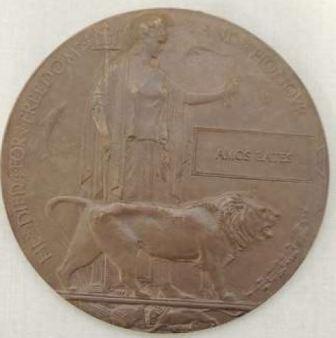
The Museum has two of these items in its collection. The Dead Man’s Penny is a bronze plaque of condolence which was issued after the First World War to the next of kin of British and Empire service personnel who were killed as a result of the War. This memorial was commissioned by the War Government who recognised the need to both honour the fallen and also show gratitude to their next of kin and 1,355,000 were issued.
The name Dead Man’s Penny was given because of the similarity in appearance to the much smaller penny coin. Issue continued into the 1930s to ensure all who died as a consequence of the War were commemorated.
This particular Dead Man’s Penny is in honour of local man, Amos Bates.

There are many stories about The Thatched Barn : famous frolicking actors before the War, fire destroying the thatch after the War, but the best stories come from its secret work for the SOE during the War. Over 200 local film craftspeople well versed in deceiving the camera with prosthetics, wigs, makeup, and props that looked like one thing but were really another, worked on equipping our secret agents. From exploding cigarettes, lumps of coal and rats, to radio suitcases with false bottoms, from fake German money and Nazi documents to a one man submarine tested in the Barn’s swimming pool. The full story is here on the second page of our May 2017 Newsletter.
Here’s one local gentleman’s story about the Barn : “… mention was made of wartime experiences at The Thatched Barn. I was told about this when having my haircut by Mr Battle, the barber operating from Theobald Street, near Tompkins, the butchers and later at the top of Theobald Street, opposite the Crown. It was about 1962 when he told me that during WW2 he had to sign the Official Secrets Act and told to report to the Thatched Barn. When he arrived, the chap on the gate let him in and directed him to a door on which he knocked. Imagine his surprise when the door was opened by a soldier dressed in a German uniform. Mr Battle told me that he went there many times to cut hair in a German fashion for agents that were going to be sent to Germany and during his many visits, he heard only German spoken.” David Clark
If you have a story – please post it on our Facebook page!

Show only:
» Events
» Collections
» News
» Exhibitions
Elstree & Borehamwood Museum
96 Shenley Road
Borehamwood
Herts
WD6 1EB
Tel: 01442 454888


Admission: Free
Opening times:
Opening times:
Tuesday, Wednesday, Thursday
12pm - 6pm
Saturday 10am - 3pm
Registered Charity No.1157770


