Welcome to the Elstree & Borehamwood Museum blog.
This blog is about all those happenings inside and outside the Museum that have caught our attention.
From events and exhibitions, to new discoveries in the collections, to news and views.
Any comments and items to go here please contact Simon on info@elstree-museum.org.uk
Whilst the Museum is closed and our collections unable to be seen by visitors, we have created a weekly virtual museum with an Object of the Week feature from our collections.

Object of the Week : V is for Village Hall
Housed on the site that was the much loved Village Hall, the Museum has close links with this building which played a big part in community history and local memories. We have a collection of photos of the Village Hall on our archive database. We always welcome more photos for our collections, so please do share if you can.
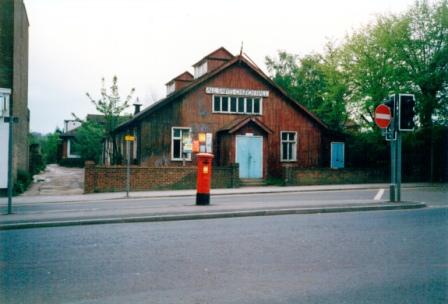
The 'Village Hall' known as the Church Hall, was opened next to All Saints Parish Church on Friday 2nd February 1926. The following afternoon a whist drive took place followed by a public dance with the 'Pogo' orchestra of banjo, piano, violin and cello. On Sunday the hall was welcomed for use by the Sunday school. Thus began an extension of the social life of the growing village of Borehamwood.
The prefabricated corrugated iron structure of the Hall was inspired by the social hall belonging to the Wellington and Ward photographic factory in Shenley Road (known as the Dufay Hall when that firm had the premises.) The 1920s saw the era of ‘Tin Tabernacles’ made of this metal, which resisted bending.
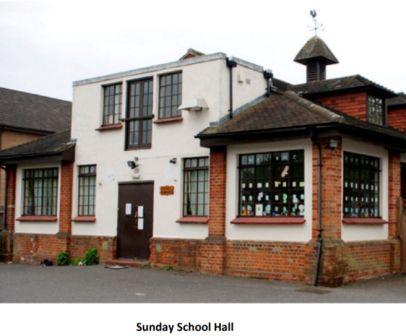
By 1936 arrangements were completed for the erection behind the Village Hall of the new brick built Sunday School Hall. During World War II the Village Hall, because of the central position, was requisitioned for government use. In the early War years it was an A.R.P. Post and ambulance station, also used in liaison with Police and Fire Services and local Hospitals, and with public utilities for water, gas and electricity. From 1943 the Village Hall did service as a ‘British Restaurant’ run by the government at subsidised rates, providing lunchtime meals, (ration book free ) for one shilling. Along with these activities, on Saturday afternoons the Hall was transformed for evening dances; a welcome social event for Servicemen and women based in the area mixing with local people.

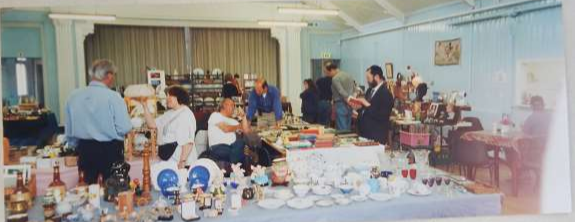
In the 1950s both the Village Hall and the Sunday school hall were being used for a great deal of community and church related activities, meetings, dances, Easter and Christmas bazaars, The May Festival, Scouts and Guides, jumble sales, plays, film shows, exhibitions, cage bird shows, garden show, whist drives, annual dinners, talks, concerts etc. An interesting record of diversity. A weekly ‘flea’ market thrived until it closed down. Blood donation sessions were held there as well on a regular basis. In the late 1950s and early 1960s ‘Lucky’ Parkinson promoted Rock & Roll shows in The Hall, and the likes of Screaming Lord Sutch & The Savages, The Brook Brothers and Johnny Kidd & The Pirates would shake the foundations.
During the mid 1990s, a working party was set up with All Saints Church liaising with the Trustees to look into the future of the halls. One idea was to demolish the front hall, remove the wooden pews from the church and use the church space as a multi purpose facility for the community. However, by this time the front hall had become rather dilapidated and despite a makeover it remained in a poor state. Yet the hall, being in such a central location was a much loved and missed feature of the village.
By October 2008 plans were prepared for the new community hall. This was to be a building of substance, balancing All Saints church itself, rising a storey above nearby shopping premises. The Library was to be accommodated with the inclusion of the Local museum and various meeting halls and rooms. The multi functional community building of 96 Shenley Road opened in 2013.

Whilst the Museum is closed and our collections unable to be seen by visitors, we have created a weekly virtual museum with an Object of the Week feature from our collections.
Object of the Week : U for Underwear
The Museum has a rather nice collection of lingerie produced by Keystone Knitting Mills. As the history of Keystone has been covered previously in ‘K’, it doesn’t need repeating here. Also, we all know what underwear is and what its functions are, so that’s probably best not repeated here either. However, these are items of a Museum collection, so let’s look at a bit of history.
The earliest undergarment to be worn by human beings is thought to be the Loincloth and as Tarzan fans will know, sometimes in hot weather would have been the only item of ‘clothing’ to be worn. In colder climates, the loincloth would be worn under other garments. The fabric used for loincloths was believed to have been either wool or linen or a coarse twill. Scratchy.
As time progressed, men wore cod-pieces and ladies wore bodices which later became corsets.
By the early 20th century, textile industries like Keystones were booming. Whalebone corsets began to be relaxed and be replaced by the liberty bodice. Advertising for underwear first began in 1910 in the US and by the end of the decade, the requirement was for ladies to have underwear in which they could pursue sporting activities, so the bloomers were born.
In the 1930s, the girdle revived the fashion for the corset, but without the whalebone and accompanied by a brassiere and garters.
From the 1950s onwards, underwear became more of a fashion item in its own right and items such as the Wonderbra, Pantyhose (or tights), brief and boxer shorts came into production.


Whilst the Museum is closed and our collections unable to be seen by visitors, we have created a weekly virtual museum with an Object of the Week feature from our collections.
Object of the Week : T is for Thatched Barn
The Museum has a large collection of photos of the Thatched Barn, now the Holiday Inn on the Barnet By-Pass. This building has had a colourful past and our archive photo collections reflect this. There have been parties, summertime gatherings around the former heated swimming pool, car accidents in the 1930s, secret wartime activities and fires in the 1960s. Here are some unseen photos from the opening night collection in 1934.


The hotel had elaborate dining facilities and being so close to the film studios, it became a glamorous hang-out for the film stars of the 1930s. It was bought by holiday camps’ founder Billy Butlin in 1939 but then during the Second World War, the building was requisitioned by the Special Operations Executive (SOE) who developed explosive devices, camouflage and coding equipment, using the local expertise found in the studios. By the end of the war, the building had fallen into disrepair and the owner went bankrupt. But then, in the 1950s, the Ministry of Works used the Thatched Barn as its Building Research Station.


In 1962 it suffered the first of a series of fires which damaged the thatched roof for which it was famous. It then became a Playboy Club for a brief period in the Sixties but prohibitively high prices and an exclusive membership ensured its eventual failure. The Thatched Barn was demolished in December 1989.
Whilst the Museum is closed and our collections unable to be seen by visitors, we have created a weekly virtual museum with an Object of the Week feature from our collections.
Object of the Week : S is for Shopping


Carrier bags are contentious these days, outlawed for their plastic content but they also have an evocative quality, reminding us of shops past and present. The Museum holds a collection of various bags from shops long gone in Borehamwood, together with other shop related items, including weighing scales, receipts and shop-front lettering as well as a large archive of photographs.


The story of shops and shopping in Borehamwood may be said to start with ‘Robinson’s Folly’; a row of shops on the east side of Theobald Street in 1871. In fact, Theobald Street was where almost all the earliest shops and houses were situated and was the original village centre which is why Borehamwood folk say “ going down the village” to this day.
In 1939, Borehamwood was a small town developing around its main thoroughfare, Shenley Road. Until the mid-1920s, most shops and houses had been built at the west end of the road; the east end was mostly isolated. By the mid ‘20s the film studios arrived and housing sprung up. New shopping parades followed in the late 1940s and were mainly completed by the end of the 1960s. Shenley Road looks much today as it did then.


Tesco and Sainsbury’s were some of the first multiple stores to introduce self-service. Tesco came to Borehamwood circa 1954 and was first positioned opposite Whitehouse Avenue, where Borehamwood Café is today. By the late 1950s it then occupied the site where Lots of Rice now stands and then the current site of the Reel Cinema in the 1980s. It finally moved to its present position on former Elstree Studio land in the 1990s.

Whilst the Museum is closed and our collections unable to be seen by visitors, we have created a weekly virtual museum with an Object of the Week feature from our collections.
Object of the Week :
R is for Red Lions – Three of them!
Elstree and Borehamwood has had its fair share of pubs named Red Lion.

The Red Lion Hotel on the crossroads at Elstree was a timber framed building and first mentioned in 1656. It stood on the East side of the High Street on the corner of Barnet Lane and was demolished in 1934 to allow for the widening of the road.

This is the Red Lion in Shenley Road which is now McDonalds but previously was a pub since the mid 1930s. This was particularly popular with film stars from the Studios across the road, who would pop in for a drink and chat with fellow actors. A darts team from the old Red Lion in Borehamwood was almost crowned national pub champions when they took part in a tournament in the late 1940s. On Wednesdays in the 1960s it was home to the Boreham Wood & Elstree Folk Music Club where many up-and-coming artists played from Sandy Denny to Bert Jansch. And on Saturdays featured middle of the road and cabaret artists such as Lennie Peters, later to be one half of top popsters Peters and Lee.

Here we see the Old Red Lion in Green Street which closed in the late 1960s. In the 1940s and 1950s life used to revolve around the Red Lion pub and the area had a real sense of community. The interior was described as very Spartan with bare boards on the floor and no carpets and served real ale. There was no licence to sell spirits and wine wasn’t as popular then as it is today. The pub had two bars but according to local memories, one was seldom used.
Whilst the Museum is closed and our collections unable to be seen by visitors, we have created a weekly virtual museum with an Object of the Week feature from our collections.

Object of the Week :
Q is for Queen – the Pearly variety
This is one of a large collection of unusual hand-made paper figures made by W.H Gilby. Mr Gilby worked as a draughtsman at BSP Industries in Maxwell Road, Borehamwood, which was founded and owned by Ivor Bailey. BSP was home to the largest European engineering drawing office of its time. Ivor Bailey’s name might have a familiar ring locally too because he gifted the Maxwell Park community centre to the youth of Borehamwood in 1962 and financed the building work.
Mr Gilby was Ivor Bailey’s right hand man and he made the paper figures as table decorations for the annual dinner given by BSP. Gilby also drew this image of the old Holly Bush inn.


Whilst the Museum is closed and our collections unable to be seen by visitors, we have created a weekly virtual museum with an Object of the Week feature from our collections.
Object of the Week : P is for Phoenix and Paul Welsh

In the Museum’s collection is this painting of a Phoenix, which hung in the foyer of Elstree Studios.
The Phoenix rising from the ashes logo was adopted to symbolise the Save Our Studios campaign’s success at putting Elstree Studio back on the map. This photo of Paul Welsh, Chair of the Studio at the time, was taken in 1996 when the Studio reopened. It shows Paul with actress Ingrid Pitt; best remembered as a Hammer films icon and for appearing in Where Eagles Dare, which was made at MGM in Borehamwood.

Whilst the Museum is closed and our collections unable to be seen by visitors, we have created a weekly virtual museum with an Object of the Week feature from our collections.
Object of the Week : O is for Offenburg
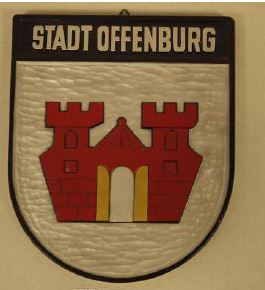

Offenburg is one of the twin towns with Elstree and Borehamwood, the other being Fontenay-aux-Roses in France.
Offenburg lies east of Strasbourg, near the Rhine Valley and Black Forest. Nice gateaux! The name is literally translated as ‘Open Castle’ and in the 18th Century, belonged to Austria. More information and photos can be found at the official twin town website: www.betta.org.uk Betta standing for Borehamwood and Elstree Twin Town Association.
The Twin Town Association has donated many items to the Museum over the years, including these seen here: shot glasses showing the heraldic castle and the Offenburg flag; a Stadt Shield (City) and a framed photograph of a statue. Betta was formed in 1982 but the town twinning movement has been going since 1945, shortly after World War II ended, on the premise that Europe should never again be torn apart by war. The rationale behind town twinning is the pairing of towns or cities from geographically distinct areas, in order to foster human contact and share cultural links. It also provides an opportunity to share problems, exchange views and understand different viewpoints on any issue where there is shared interest or concern.



Whilst the Museum is closed and our collections unable to be seen by visitors, we have created a weekly virtual museum with an Object of the Week feature from our collections.
Object of the Week : N is for Nuclear Disarmament
A Borehamwood resident and prominent member of the TUC, donated a box of personal items to the museum some time ago. Amongst various papers and books, were items relating to the Campaign for Nuclear Disarmament. The donor had been a passionate protester during the 1980s demonstrations and amongst the belongings donated were fliers, posters, badges and papers.
Between 1980 and 1983, CND’s membership soared, in part in criticism of the Thatcher government’s CND objectives and heightened by increasing tension between the Superpowers. This made it one of the largest political organisations in Britain and possibly the largest peace movement globally. Glastonbury Festival played a key role during this period (a ‘first wave’ including the Aldermarston marches had occurred between 1957-1963), and June 1981 saw the first Glastonbury CND Festival. You may recall the Government’s defence plans outlined in an official booklet ‘Protect and Survive’. It was renamed by protestors as ‘Protest and Survive’. This also formed part of a series of frightening public information films designed to instruct the public how to survive a nuclear attack. In 1984, the drama Threads was produced, which explicitly depicted the after effects of nuclear war.


The Trident missile replaced the Polaris armed submarine fleet and the Greenham Common Women’s Peace Camp focussed attention on the Cruise Missiles and tracked their movement around the country, blocking public roads. Eventually the missiles had to travel under cover of night and with a police escort.
The re-election of a Conservative government in 1983 and the defeat of left-wing parties in continental Europe made the deployment of Cruise missiles inevitable and the movement again began to lose steam.
Whilst the Museum is closed and our collections unable to be seen by visitors, we have created a weekly virtual museum with an Object of the Week feature from our collections.
Object of the Week : M is for MGM


This year commemorates the 50th anniversary of the closure of MGM Studios in Borehamwood.
MGM British was a subsidiary of Metro-Goldwyn-Mayer and construction for the Studios began on the north side of Elstree Way in 1935. This site was bordered by Shenley Road and adjacent to Thrift Farm. The Studios were sold to J Arthur Rank in 1938 and during the Second World War were requisitioned by the British Government for war work.
Films made here included Ivanhoe (1952) and The Dirty Dozen (1967). The castle built as a set for Ivanhoe could be seen when driving into Borehamwood and was often mistaken for a genuine historical monument. The mound where the castle was built, is now part of the Film and Heritage Trail which runs through the Studio Way estate.
In 1970, the Studios closed and in the early hours of May 1973, a fire swept through the site, damaging a number of buildings being demolished in preparation for use as a cold store by Christian Salvesen. During 1973, a film crew for the production Holiday On The Buses filmed some of the demolition work as part of the climax of the film.
In 1987, despite local campaigns and protests, the iconic Clock Tower was demolished when Christian Salvesen finished operations at the former studio. Unfortunately none of the buildings were listed and the site was cleared for industrial purposes. The former library and leisure centre were built on an adjacent site and the backlot became the Studio Way estate. According to former Museum Curator, Alan Lawrence, only a few bricks remain from the original wall alongside the road, marking where the Studios once stood.


This Polaroid Swinger camera, in the Museum’s collection, was used by MGM staff to record actors and sets in the 1960s.

The Plaster Vase is part of the private collection of Paul Welsh and was loaned to the Museum for display. The vase was used to decorate sets and actors’ dressing rooms with flowers.
A book about the history of MGM has been written by local historian Paul Welsh and can be purchased from http://elstreescreenheritage.org/

Show only:
» Events
» Collections
» News
» Exhibitions
Elstree & Borehamwood Museum
96 Shenley Road
Borehamwood
Herts
WD6 1EB
Tel: 01442 454888


Admission: Free
Opening times:
Opening times:
Tuesday, Wednesday, Thursday
12pm - 6pm
Saturday 10am - 3pm
Registered Charity No.1157770


