Welcome to the Elstree & Borehamwood Museum blog.
This blog is about all those happenings inside and outside the Museum that have caught our attention.
From events and exhibitions, to new discoveries in the collections, to news and views.
Any comments and items to go here please contact Simon on info@elstree-museum.org.uk
Whilst the Museum is closed and our collections unable to be seen by visitors, we have created a weekly virtual museum with an Object of the Week feature from our collections.
Object of the Week : Q is for Queen of the May

The Crowning of the May Queen
In the 1920s and 30s, the Village May Queen Parade was a huge event in Elstree and Borehamwood, with hundreds of people lining the route through Elstree Hill, Barnet Lane, Deacon’s Hill and Shenley Road to watch the carnival pass by. In the procession there were men, women and children in colourful costumes, the Village May Queen and her attendants and the Elstree and British International Pictures Fire Brigade.
Our very own Ann Lawrence, Trustee and one of the instigators of the first Elstree and Borehamwood Museum in Drayton Rd, carried out extensive research into the crowning of the May Queen and the local annual Parade. When the Museum first opened, one of the volunteers brought in photographs of the May Day celebrations and they were put on display. Over time many people came forward with photographs and stories of their time as the May Queen, as well as describing their memories of the event, resulting in a large collection of accounts.
Although there is photographic evidence from the Twenties, the first recorded May Queen was Nita Willets in 1936. However, Ann Lawrence's research shows it was originally thought Kath Gates was the first May Queen in 1932.
The May Queen was chosen from the All Saints Church bible class, run by Mrs Bristol from her home in Mildred Avenue. The chosen Queen was around 14 years old and was selected by her peers. Ann Lawrence explains that it was seen as desirable for the chosen girl to be a teacher to younger children within the religious community.
Ann tells us: On May Day, a parade of decorated cars and floats followed a route from Chestnut Tree Drive, Aldenham, to Meadow Road Recreation Ground. It was customary for the vicar to present the newly-crowned May Queen with a Bible. In the Thirties, it was proposed there should be a special dress for the May Queen. It was made and embroidered with a cross, crown, and ribbon motif. Having last been worn in 1977, the whereabouts of the dress is now unknown.
In 1936, the May Queen was crowned by film star Diane Napier, who lived at a house called Villa Capri in Allum Lane, and had made several movies at Elstree Studios, including Heart's Desire in 1935 with her fiancé, the opera singer Richard Tauber, and Mimi with Douglas Fairbanks Jr. The event attracted hundreds of villagers along with people from Barnet and St Albans.
The May Day celebrations raised money for projects within the local community. In 1936, the amount raised contributed to the building of All Saints school hall. In 1958 the funds contributed to a new tower for the church.
The last May Queen is thought to have been Jaqui Rowson in 1977. Elstree and Borehamwood Museum has collected details of all the May Queens from 1932 to 1977 and Ann’s volume and photograph collection can be viewed at the Museum once we re-open again.
However, details of the 1972 May Queen has continued to elude Ann Lawrence, so if anyone has any information, do get in touch with us.

The Procession passing the Borehamwood Day Nursery
Whilst the Museum is closed and our collections unable to be seen by visitors, we have created a weekly virtual museum with an Object of the Week feature from our collections.
Object of the Week : P is for Prince Philip
On 17th May 1963, the Duke of Edinburgh came to Boreham Wood to visit Elliott Automation. Sadly we don’t appear to have any photos of this event, but we do have the special press pass issued to local journalist Rod Brewster, by Buckingham Palace, in the collection. The Duke is believed to have arrived by helicopter, landing on what is now to be the Sky Studios site.

Elliott Automation was an early computer company of the 1950s–60s. Its roots can be traced back to the 18th Century from a firm of instrument makers founded by William Elliott in London. The research laboratories were set up in Boreham Wood in 1946 and the first Elliott 152 computer appeared in 1950.
The company was influential and employed a great deal of local people and some prominent computer scientists.

In 1967, Elliott Automation was merged into the English Electric company and in 1968 the computer part of the company was taken over by International Computers and Tabulators (ICT). This company was renamed Marconi Elliott Computer Systems Limited in 1969 and GEC Computers Limited in 1972. The remainder of Elliott Automation which produced aircraft instruments and control systems, was retained by English Electric. Almost 50 years after Prince Phillip’s visit, the building was demolished in 2012.

Keeping with the Prince Philip theme, the Museum has this Royal Wedding souvenir programme from 1947. This is of course the wedding of Princess Elizabeth and Philip Mountbatten, which took place on 20th November 1947 at Westminster Abbey.

Whilst the Museum is closed and our collections unable to be seen by visitors, we have created a weekly virtual museum with an Object of the Week feature from our collections.
Object of the Week : O is for Opperman

At the turn of the 20th Century, Stirling Corner was just farm fields and tracks. Barnet Lane, which ran between Elstree and Barnet Gate, existed prior to 1777. Then in 1926 the Barnet Bypass was built in response to the growth of car use, and a Mr Stirling opened a garage where the Shell petrol station now stands – hence Stirling Corner and Stirling Way.
It was on the corner where Morrisons now stands that at the beginning of WW2, S E Opperman Ltd built their factory and it was the only second factory along this stretch of the A1. The roots of the company go back to 1862, with the founding of a watch making and engineering business in Clerkenwell, by Carl Oppermann, a native of Hamburg. Between 1898 and 1907, the firm appears to have produced and sold electric cars, and then reverted to more general engineering, focussing, in particular, on weapons and aeroplane components during the Second World War. They were known for making gears, and so they undertook making gearboxes for tanks. Two products which came later were the Motocart truck 1947–53, and the Unicar from 1956-59. It was the cheapest car at the 1956 London Motor Show, but only about 200 were sold, and their next model, the Stirling, was only a prototype. Their motor manufacturing business ended in 1959, eclipsed by the production of the Mini.
In the late 60s the company was sold to Stratford Safe Co, and later became John Tan who continued the business, and then the site became a retail park. Who remembers World of Leather, CarpetRight, Currys, Smyth’s Toys and Homebase being here?


Whilst the Museum is closed and our collections unable to be seen by visitors, we have created a weekly virtual museum with an Object of the Week feature from our collections.
Object of the Week : N is for Napoleon Death Mask

This extraordinary object is part of the Museum’s collection and was, until recently, on display, intriguing visitors.
After his final defeat at the battle of Waterloo in 1815, Napoleon was exiled to the British controlled island of St Helena, a remote windswept rock in the South Atlantic. He died there, probably of stomach cancer, in 1821 at the age of just 51. He was attended in his final days by both French and British physicians. During the time of Napoleon Bonaparte, it was customary to cast a death mask of a great leader who had recently died. Although there is some debate as to who took the original death mask, it was very probably Dr Francis Burton of Britain's 66th Regiment who also presided at the Emperor's autopsy.
A mixture of wax or plaster was carefully placed over Napoleon's face and removed after the form had hardened. From this impression, subsequent copies were cast. Much mystery and controversy surrounds the origins and whereabouts of the original cast moulds. There are only four genuine death masks known to exist. The death mask is important because it is a direct mould of his face and is more representative of what he looked like than a painting.
All very interesting you may say, but where is the connection to our area? For the answer to this question we must look at Barham House (later Hillside) in Allum Lane, Elstree, where in the early 1800s lived a wealthy merchant, Richard Baker and his daughter Martha. Martha married Lt Colonel Joseph Burton, brother of the aforementioned Dr Francis Burton, physician to Napoleon on St Helena and probable originator of his death mask.
Martha and Joseph Burton had a son, Richard Burton, who became a famous explorer and whose remarkable journeys to the Holy cities of Mecca and Medina, astounded Victorian society and made him famous. He spent many months trying to find the source of the Nile (the Holy Grail for explorers of the time) but despite braving hostile tribes and tropical diseases, was unsuccessful. In his later years he translated the Indian Kama Sutra into English (anonymously) and then produced a 16 volume, no holds barred, translation of the Arabian Nights (somewhat more adult than Sinbad the Sailor would suggest) which he published under his own name. When he died in Trieste in 1890 his wife burned all his diaries and manuscripts and 40 years of work, written by this extraordinary man, went up in smoke. Sir Richard Burton (he was knighted in 1886) must surely be the most interesting and colourful of the prominent people we can associate with our area.
Whilst the Museum is closed and our collections unable to be seen by visitors, we have created a weekly virtual museum with an Object of the Week feature from our collections.
Object of the Week M is for Museum
In 1999, a group of volunteers began archiving photographs and documents relating to the history of Elstree and Borehamwood, because there was no dedicated museum for the area. This group, calling themselves the Community History Project, was given premises alongside the local newspaper in Drayton Road, which comprised of one room, an office and a kitchen area. As local people became more aware of the group, more objects and artefacts began to be donated to the Community History Project. Hertsmere Borough Council supported the Project in 2000 with a small grant and provision of a Museums Officer to give advice and guidance to the volunteers.


The Original Museum - outside and inside
The Editor of the newspaper would provide his neighbours with photographs which contributed to the now large image archive held by the Museum. The volunteers began producing themed displays of local historical topics and the programme also included talks to local groups and schools and the provision of a valuable enquiry service to the local community. The Museum opened Thursday – Saturday 11am – 3pm and admission was free.
When plans to create a new multi-use community facility on the site of the Village Hall were announced in 2011, the Museum was allocated a dedicated space on the second floor. With funding from the Heritage Lottery and Hertsmere Borough Council, the Museum as we know it today, was opened in November 2013. More volunteers were recruited and the Museum embarked on a wider programme of talks, walks and a monthly reminiscence group meeting. A dedicated team was set up to catalogue every item in the collection and this work is ongoing, only halted in the past year because of the pandemic.
The Museum holds around 6,000 objects and over 7,000 photographs. These objects range from items from the area’s film and television heritage, social and industrial history, archaeology, photographic collections, paper ephemera, costume and textiles, clocks and scientific instruments, maps and plans, fine art and ceramic collections.
In addition to actual collections, the Museum holds a large resource of reference material such as scrapbooks, news cuttings and other information relating to objects within the collection and people and places associated with those objects.
Come and visit when we are allowed to re-open. Announcements will be made on social media and our website.


The Museum today - The desk and displays

At long last Spring is here! This is our entry for the Borehamwood Spring Photos you will see around town. Nice!
Whilst the Museum is closed and our collections unable to be seen by visitors, we have created a weekly virtual museum with an Object of the Week feature from our collections.
Object of the Week : L is for Lilley’s

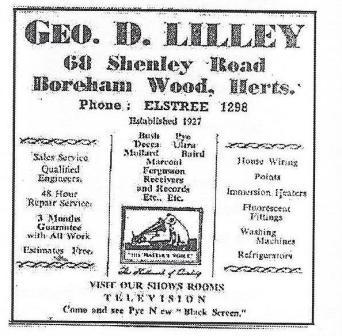
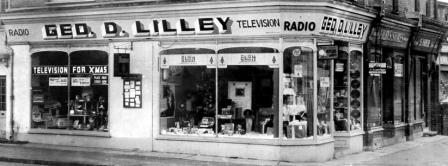
The Museum’s photo archive contains many images of Shenley Road over the years. Here, the white shop on the corner of Shenley and Furzehill Roads was bought by Geoffrey Lilley in 1943. His wife was made manager while he worked in an aero factory on Spitfires. When the war ended he returned and built up a business that by 1951 was one of the most extensive radio & electrical shops in South Hertfordshire.


In the 1950s and 60s Lilley’s became the place to buy your LPs.

The adverts amd more can be found in From Ladbroke Grove To Boreham Wood by Vic Rowntree - online sales from this website.
Whilst the Museum is closed and our collections unable to be seen by visitors, we have created a weekly virtual museum with an Object of the Week feature from our collections.
Object of the Week : K is for Kinks and Kings
In the summer of 1968, Ray Davies, from 60s group The Kinks, moved with his wife Rasa to a large house in Red Road. At the time it was called the Kings House, with its connected and adjacent smaller property called Kings Cottage. But when it was built around the turn of the century it was called The Gables. Bought by the actor Martin Benson in the 1950s after his huge success in The King And I in which he played the character Kralahome, he renamed it Kings House. Ray bought it from Martin, and here he wrote some of his best songs.


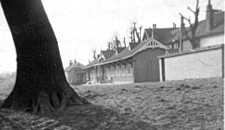
Only a nod to The Gables exists in the naming of the nearby estate. Its location was close by the Sion Convent and the nuns often complained about the noise of music coming from it. You can see from this photograph of Sion Convent Pavilion, the building in the background would have been The Gables. We only have maps now to show the location of this large house. The building had been much modified since the 1950s.


Early map showing The Gables and its tennis court in Red Road Close up on map of The Gables and the Sion Convent Pavilion
Meanwhile, during his time in Borehamwood, locals would see Ray Davies visiting the Wellington or buying his evening paper from Coles Arcade. He played football against Elliotts for a celebrity team, but mostly wrote his songs. The band would rehearse them in the Cottage and it was a creative period for Ray. He wrote the title track of We Are The Village Green Preservation Society here – one line “God save Tudor houses, antique tables, and billiards” probably inspired by his house - and he wrote the album Arthur (Or the Decline and Fall of the British Empire). It was released in 1969 to rave reviews, and gave the Kinks an entry back to the States. Ray perfectly summed up the feelings for a lost England ‘destroyed’ by the march of progress, and this would be especially poignant in Boreham Wood as it entered the 70s and a period of growth and change.
But Ray was missing his Muswell Hill roots and sold Kings House in 1969 to move back. It was knocked down, leaving the Cottage which still survives. It is reported that the wooden panels from the ballroom were liberated and went to the Cat & Fiddle in Radlett, though that is unconfirmed. Unfortunately we have no photos of the House or Ray in Boreham Wood, just some wonderful music inspired, possibly, by Red Road!
Whilst the Museum is closed and our collections unable to be seen by visitors, we have created a weekly virtual museum with an Object of the Week feature from our collections.
Object of the Week : J is for Jam and Jerusalem
Some of our current and past volunteers have been long serving members of the Borehamwood Women’s Institute. The Museum was donated a plaque from the Borehamwood WI, which had been presented to the Church Hall in January 1928. A very active and charitable organisation, the Borehamwood WI were much more than just Jam and Jerusalem.

Founder Members of the Boreham Wood W. I.
The Borehamwood Women's Institute held its first meeting on 12th October 1923 at All Saints Church Hall. A committee was formed with Mrs Wellington as President and Miss Jarrow as Vice President. At the first December Meeting members witnessed 'How to make a Christmas Pudding' which cost £1.10 shillings and six members sang. The Bring & Buy Sale stall made of profit of 16 shillings. The Year's programme was prepared including a Trip to the Wembley Exhibition and help was given to the Elstree Flower Show assisting Aldenham WI with the Clockwork Golf Competition. Other notable events of the year included the purchasing of Crockery and the recovering of hats (an essential item of women's clothing at the time). First Aid Instruction to help care for the sick was given by a nurse, as Doctors visits were very expensive.

The Plaque, January 1928
As the years went on, dancing, drama, whist drives and speakers were included in the programme and a choir was formed. Meetings were closed with the singing of the National Anthem. Borehamwood won the County Talent Competition and the prize was a ton of coal. Philanthropic activities included collecting eggs for Wellhouse Hospital for Elderly Ladies, children’s parties and the collection of jam and eggs for the Pawling Home. During Wartime, cloth and hot water bottles were collected for the First Aid Post. Woollen comforters were knitted for the Forces and vegetables were grown for charitable causes. Toys were donated at Christmas time for the Red Cross to distribute
In 1944 Mr Lancashire, Clerk of Elstree Council asked WI members to help at the British Restaurant and in 1945, a written request was received from a devastated Holland resulting in Members collecting gifts for them. Also requests were made by the ERDC (Elstree Rural District Council) for ideas to construct a village hall including a Kitchen, Craft Rooms, and welfare facilities. During the 1950s the population of the area increased substantially as many Londoners moved here to the new council estates being built. In 1952 ERDC wanted suggestions for the Railway Station Sign which was originally Borehamwood for Elstree. 1957 marked the 35th Birthday of the W1. In 1958 a trip to see 'My Fair Lady' was arranged. Raffle Profits were sent to the Philippines Scout Rally.
By 1970 membership had dropped to 97. The Drama Group were still doing Pantomimes and talks included Eastern Gas, Green Shield Stamps and Love Spoons. 1983 marked the 60th Birthday and a talk called 'Hunting Treasure with a Metal Detector'. During 1990 members attended the Family Fun Day at the Bowes-Lyons Home, St. Paul's Walden Bury and it was a great success. At the December meeting members were entertained by Mr John Heddle Nash, an Opera Singer who had sang for the Royal Family at Buckingham Palace and Sandringham. The new Millennium 2000 Strathglade Dancing Group entertained members and talks included "Bats in the Belfry" and Tudor Fashion.
2023 will see the 100th anniversary. We wait to see what celebrations we can expect, in a very different world.
Whilst the Museum is closed and our collections unable to be seen by visitors, we have created a weekly virtual museum with an Object of the Week feature from our collections.
Object of the Week : I for Mr Innocenti
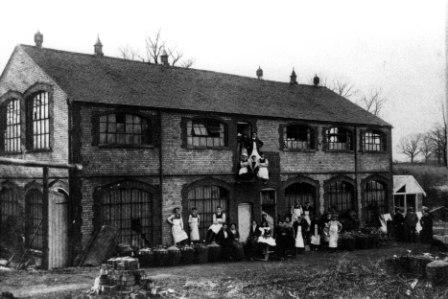

Cambi Hat Factory 73a Shenley Road Innocenti when young
The Italian family of Cambi began bleaching and dyeing Panama hats in 1908, and thus were one of the earliest employers in Borehamwood. Mr Innocenti ran the Cambi Panama Hat Bleaching works, and was also the owner of the nearby Central Garage. The Garage was located next to Hanson’s Tea Rooms and went on selling petrol and servicing cars until the 1980s. Its site is now occupied by Nandos. The main Cambi factory was in Shenley Road, in what is now the Shopping Park and was situated approximately where Argos stands. But in 1928 Cambi Hats was sold and their building became Keystones Knitting Mills. The entrance was down a lane now called Keystone Passage.

Mr. Cambi in Shenley Road Innocenti when older
The Cambis also had a factory at the top of Drayton Road. They had developed a system for bleaching the hats white and giving them a unique glossy sheen. After processing the hats were hung on rows of pegs to dry and looked like a miniature forest of giant toadstools. Panama hats are in fact made in Equador, although they are shipped all over the world from the port of Panama, hence the probable origin of their name. In 1908 the Panama Canal was being constructed and as well as the workers on the project, both President Theodore Roosevelt and King Edward V11 were photographed wearing them. In consequence they became very popular. In more recent times the list of celebrities wearing these stylish hats is almost endless. Humphrey Bogart, Sean Connery, and Peter O'Toole all wore them. The price range of Panama hats is enormous. You can buy one for as little as £25, but for the very best which are made in the town of Montecristi, you can pay thousands of pounds. It is all down to the weaves per inch. A "superfino" Panama hat can, according to popular rumour, hold water, and when rolled for storage, pass through a wedding ring. So there we have the reason for the hat in the museum exhibits. It is amazing that an Italian family chose Borehamwood to start a business bleaching and dyeing Panama hats that are made in Equador but they did, and it is part of our history.
The Cambi hat in our Museum collection looks more like Casper the Ghost than a real Panama hat. This is because after bleaching and dyeing the hats were sent to Luton, a couple of stops up the Midland railway line, for blocking and finishing.
Apart from the Cambi hat, the Museum collection holds many photographs of the Cambi Factory as well as Central Garage. Here are some for your delight :

Central Garage before the rebuild

Central Garage later

Panama Hats drying in Shenley Road
Show only:
» Events
» Collections
» News
» Exhibitions
Elstree & Borehamwood Museum
96 Shenley Road
Borehamwood
Herts
WD6 1EB
Tel: 01442 454888


Admission: Free
Opening times:
Opening times:
Tuesday, Wednesday, Thursday
12pm - 6pm
Saturday 10am - 3pm
Registered Charity No.1157770


